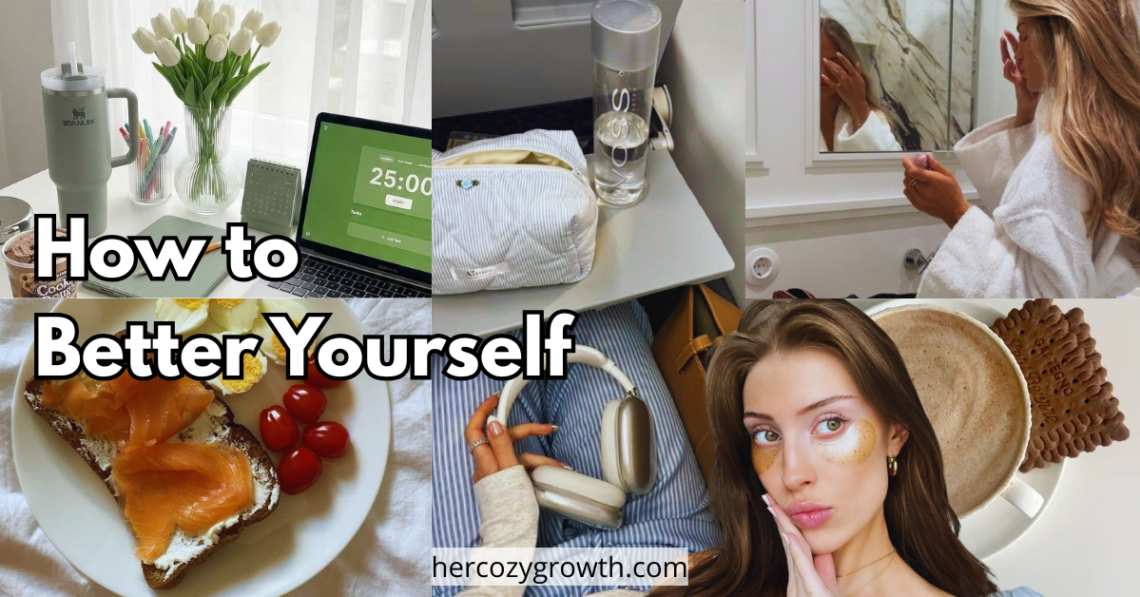
How to Better Yourself: A Gentle Personal Growth Guide for Women
Most self-improvement advice sounds great in theory and falls apart by Wednesday. Not because you lack discipline — but because the approach is wrong.
This guide is for women who want to grow in a way that is sustainable, gentle, and actually enjoyable. No 5am wake-up calls required.
To better yourself, start by choosing one area of your life to improve — your mindset, health, habits, or relationships — and make one small, consistent change per week.
The most effective self-improvement strategy is not intensity, it is repetition. Small actions compound over time into significant results.
Focus first on sleep, daily movement, and one learning habit. These three form the foundation that makes every other improvement easier.

Bettering yourself is not about fixing what is broken. It is about consciously choosing who you want to become — and then building your days around that vision, one small habit at a time.
The research is clear: lasting personal growth does not come from motivation or willpower. It comes from systems. When you build the right environment and the right habits, growth happens almost automatically.
1. Get Clear on Who You Want to Become
Before you change anything, you need a direction. Personal growth without intention is just restlessness.
Take ten minutes to write down answers to these three questions: What kind of woman do I want to be in one year? What habits does she have? What has she let go of?
This identity-based approach — made famous by James Clear in Atomic Habits — is more effective than goal-setting alone. When you know who you are becoming, decisions become easier.
2. Fix Your Sleep Before Anything Else
If you want to better yourself, start with the thing that affects every other area of your life: sleep. Cognitive function, emotional regulation, metabolism, skin health, and motivation are all directly tied to sleep quality.
Aim for seven to nine hours of consistent sleep — going to bed and waking up at roughly the same time every day. Even one hour of improvement in sleep quality can meaningfully change your mood and decision-making.
For a complete evening routine that supports better sleep, read The Ultimate Cozy Winter Night Routine.

3. Build One Habit at a Time
The biggest mistake people make when trying to better themselves is attempting to change everything at once. Willpower is finite. Trying to overhaul your diet, exercise routine, sleep, finances, and social life simultaneously guarantees failure for most of them.
Instead, choose one habit per month. Give it your full focus. By the end of the year, you will have built twelve new habits — which is transformative.
- Week 1: Add the habit to an existing routine (habit stacking)
- Week 2–3: Adjust and troubleshoot what is not working
- Week 4: Solidify and plan the next habit
4. Read or Learn Something New Every Day
One of the highest-leverage habits you can build is daily learning. Even ten minutes of reading — not scrolling, not watching — builds knowledge, improves focus, and broadens your perspective over time.
Ten pages a day adds up to twelve to fifteen books per year. That is twelve new frameworks, twelve new ways of seeing the world, twelve potential turning points.
For curated book recommendations, explore 15 Best Self Development Books Every Woman Should Read for Personal Growth.
5. Move Your Body — Even When You Do Not Feel Like It
Physical movement is the most underrated mental health intervention available. It reduces cortisol, releases endorphins, improves sleep, sharpens focus, and builds the kind of self-efficacy that spills over into every other area of your life.
You do not need a gym membership. A 20-minute walk, a yoga video, or a dance session in your kitchen counts. The goal is consistency, not intensity.

6. Audit Your Inputs — What You Consume Shapes You
You become what you repeatedly consume. The content you watch, the conversations you have, the accounts you follow, and the thoughts you allow — all of it shapes your identity and your energy.
Do a quick audit: which of your regular inputs drain you, and which ones inspire or educate you? Subtract one draining input this week and replace it with something nourishing.
- Swap 20 minutes of social media scrolling for reading or journaling
- Unfollow accounts that trigger comparison or anxiety
- Add one educational podcast to your weekly commute or walk
- Limit news consumption to one intentional session per day
7. Invest in Your Relationships
You are the average of the five people you spend the most time with. This is not a cliché — it is neuroscience. Your social environment directly influences your habits, beliefs, and self-perception.
To better yourself, invest in relationships that challenge and support you. This might mean spending more time with people who inspire you, and less with those who keep you stuck.
8. Track Your Progress — But Gently
Progress that is not measured tends to be invisible. And invisible progress leads to the feeling that nothing is working.
You do not need a complex tracking system. A simple weekly check-in — five minutes every Sunday to reflect on what went well and what to adjust — is enough to maintain momentum and celebrate growth.
9. Practice Radical Self-Compassion
Self-improvement without self-compassion eventually becomes self-punishment. If you cannot be kind to yourself when you fall short, you will eventually stop trying.
Research by Dr. Kristin Neff shows that self-compassion — treating yourself with the same kindness you would show a close friend — actually increases resilience and motivation, not complacency. The inner critic does not make you better. Encouragement does.
For a gentle approach to building habits without perfectionism, read How to Build Gentle Habits That Actually Stick (Without Perfectionism).
10. Reset Regularly — Not Just on January 1st
Growth is not linear. There will be weeks when everything clicks and weeks when nothing does. Building a regular reset practice — monthly or seasonal — helps you course-correct without losing momentum.
A reset does not mean starting over. It means reviewing what is working, releasing what is not, and recommitting to the direction you have chosen.

Frequently Asked Questions
How do I start bettering myself when I feel completely lost?
Start with the basics: sleep, water, and one ten-minute walk per day. These three actions are not glamorous, but they create the biological foundation for everything else. When your body is rested and moving, your mind becomes clearer and change feels possible.
How long does it take to see results from self-improvement?
Small changes are noticeable within two to four weeks. Significant life changes — new habits, different thinking patterns, improved relationships — typically take three to six months of consistent effort. The key is to measure in months, not days.
Is personal growth different for women than for men?
The fundamental mechanisms — habit formation, neuroplasticity, sleep, movement — are universal. However, many women benefit from an approach that emphasizes sustainability over intensity, community over competition, and self-compassion over self-discipline. Hustle culture is not the only model of growth.
What is the best self-improvement book for women?
Atomic Habits by James Clear is the most universally applicable, covering the science of habit formation clearly and practically. For a more emotionally intelligent approach, Untamed by Glennon Doyle or The Gifts of Imperfection by Brené Brown are widely recommended starting points.
Do I need to spend money to better myself?
No. The most impactful self-improvement practices are free: consistent sleep, daily movement, reading library books, journaling, spending time in nature, and protecting your energy. Courses, coaching, and books can accelerate growth, but they are not required to start.
How do I stay consistent with self-improvement?
Consistency comes from building habits into your existing routine rather than relying on motivation. Make the habit obvious, attractive, easy, and satisfying. Track your streak. Connect the habit to your identity. And when you miss a day, miss only one — never two in a row.
Start Here, Start Small
Bettering yourself does not require a perfect plan, a fresh start, or a dramatic life overhaul. It requires one small, honest choice — made today, and then again tomorrow.
Pick one habit from this guide that resonates most with where you are right now. Start with just five minutes. Build from there.
When you are ready to build momentum across all areas of your life, bookmark this guide and explore The Ultimate Gentle Glow Up Strategy: How to Become That Girl — a complete roadmap for becoming your best self, gently.


You May Also Like

80 Positive Affirmations to Start Your Day Right (For Women Who Want to Feel Confident and Calm)

10 Cozy Winter Morning Routines to Start Your Day Calm, Productive, and Inspired