
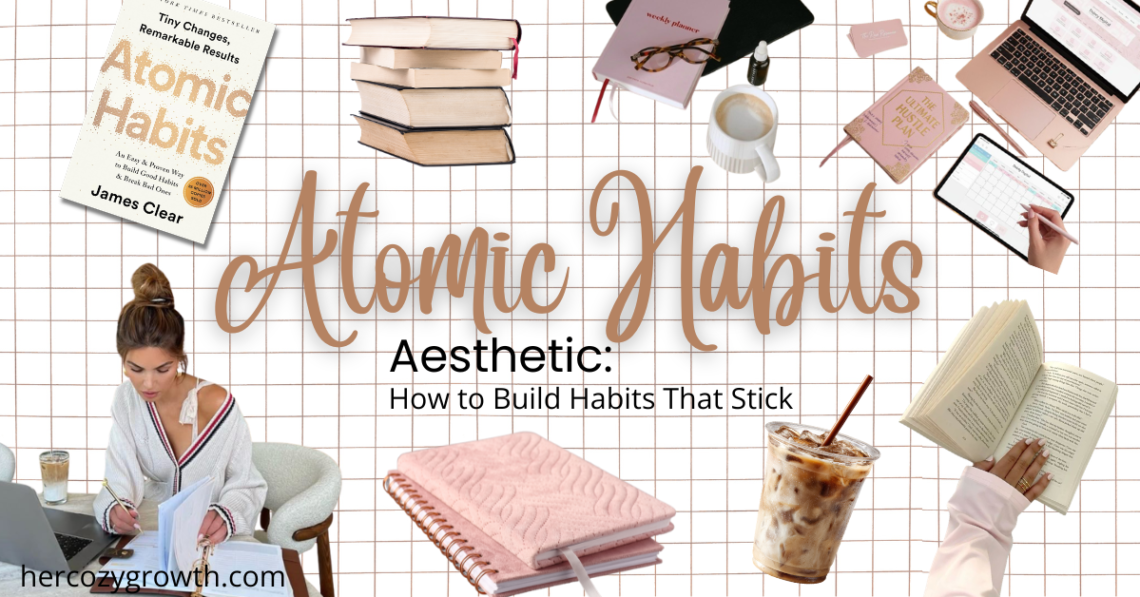
Atomic Habits Aesthetic: How to Build Habits That Stick (Without Burning Out)
Most habit advice sounds motivating for exactly three days. Then life happens, your perfect system falls apart, and you end up feeling worse about yourself than before you started. What if the problem isn’t you — it’s the approach?
The atomic habits aesthetic isn’t about willpower or 5 AM wake-ups. It’s about designing your environment, your mindset, and your daily rituals so that good habits become the easy, natural choice. It’s quiet, intentional, and built to last.
In his bestselling book, James Clear introduced the idea that getting 1% better every day doesn’t just add up — it compounds. Small, consistent actions transform into something remarkable over time. That’s the core of the atomic habits philosophy, and it’s exactly what this guide is here to help you apply.
The atomic habits aesthetic is the practice of building sustainable daily habits through small, beautifully simple systems — not drastic overhauls. It works because tiny changes are easy to maintain and compound over time into lasting personal growth.
Key methods include habit stacking, environment design, the two-minute rule, and identity-based habits — all of which make it easier to show up consistently without relying on motivation alone.

1. Start with Identity, Not Outcomes
One of the most powerful atomic habits book quotes is this: „Every action you take is a vote for the type of person you wish to become.” This reframe changes everything.
Instead of saying „I want to run a 5K,” try „I am someone who moves her body every day.” When your habit is tied to who you are — not just what you want — it becomes part of your self-image. And people protect their identity.
This is why our guide on how to build gentle habits emphasizes starting from a place of self-compassion rather than pressure. Identity-based habits are kinder and more durable.
2. Make It Obvious: Design Your Environment
Your environment is the silent architect of your behavior. The atomic habits aesthetic is deeply visual — it’s about arranging your physical and digital space so that good habits are the path of least resistance.
Want to drink more water? Put a beautiful glass on your desk. Want to read more? Leave your book on your pillow. Want to journal every morning? Set your notebook and pen next to the coffee maker the night before.
You don’t need more willpower — you need smarter cues. The easier it is to start, the more likely you are to follow through.
3. Habit Stacking: Attach New Habits to Existing Ones
Habit stacking is the practice of linking a new habit to something you already do automatically. The formula is simple: „After I [CURRENT HABIT], I will [NEW HABIT].”
- After I pour my morning coffee, I will write three things I’m grateful for.
- After I brush my teeth, I will do two minutes of stretching.
- After I sit down at my desk, I will write my top three priorities for the day.
The beauty of habit stacking is that the existing behavior becomes the trigger. No reminder apps, no alarms — just one habit naturally flowing into another.

4. The Two-Minute Rule: Lower the Bar to Start
If a habit feels too big, you won’t start. The two-minute rule solves this: scale any habit down to a version that takes two minutes or less.
| Full habit | Two-minute version |
|---|---|
| Read every night before bed | Read one page |
| Exercise daily | Put on workout clothes |
| Journal every morning | Write one sentence |
| Meditate daily | Sit quietly and take three deep breaths |
The goal is to make showing up the habit — not the full performance. Once you start, momentum usually carries you further. But even if it doesn’t — the habit is still intact. Consistency matters more than intensity, especially early on.
5. Track Progress Visually (The Satisfying Part)
There’s a reason the atomic habits aesthetic resonates so deeply on Pinterest and in productivity journals — it’s inherently visual. Tracking your habits with a simple paper tracker, habit journal, or calendar creates a chain you genuinely don’t want to break.
James Clear calls this „don’t break the chain.” Seeing your streak grow is surprisingly motivating, and checking off that small box releases a tiny but real hit of satisfaction.
If you love mornings, check out our best morning routine guide for ideas on building a tracker into your AM ritual — it pairs beautifully with a habit journal.
6. Make It Attractive: Bundle Habits with Things You Enjoy
You’re more likely to stick with a habit if you look forward to it. Temptation bundling is the practice of pairing something you want to do with something you need to do.
- Only listen to your favorite podcast while going for a walk.
- Only watch a TV show you love while folding laundry.
- Only use a special candle or tea while journaling.
The reward becomes part of the ritual, and the habit starts to feel like a treat rather than a task. This is the cozy corner of personal improvement — and it works.

7. The 1% Better Everyday Philosophy in Practice
The phrase „1% better every day” isn’t just an inspirational quote — it’s a mathematical truth.
1.01365 = 37.78× better
A 1% decline daily compounds to nearly zero. A 1% improvement daily transforms everything.
In real life, this looks like: sleeping ten minutes earlier tonight, adding one vegetable to your lunch, putting your phone in another room during dinner. It’s not dramatic. It’s deliberate.
We’ve written a full deep-dive on the 1 percent better every day philosophy — highly recommend bookmarking it if you want the full breakdown of how compounding applies to personal growth.
8. Build a Morning Habit Anchor
Morning habits are especially powerful in the atomic habits framework because they set the tone for everything that follows. A grounded morning creates a grounded day.
You don’t need a two-hour morning routine. Even 15–20 minutes of intentional morning habits — hydrating, moving, writing one line in a journal — is enough to build momentum. The key is consistency, not complexity. Choose 2–3 morning habits you genuinely enjoy and repeat them daily. Over time, they’ll become automatic, and your mornings will feel like yours — not rushed or reactive.
9. Plan for Failure: The Art of Getting Back on Track
Every habit breaks at some point. Life interrupts. You get sick, travel, or simply have an off week. The difference between people who build lasting habits and those who don’t isn’t perfection — it’s recovery.
James Clear’s rule: „Never miss twice.” One missed day is an accident. Two in a row is the start of a new (bad) habit. So instead of guilting yourself for the missed day, focus entirely on the next one.
The atomic habits aesthetic is about gentle persistence. It’s not about being perfect — it’s about always returning.
10. Celebrate Small Wins (Seriously)
Habits are reinforced by rewards. Your brain needs to feel that the behavior was worth it. That’s why celebrating tiny wins — even just saying „yes!” or doing a small happy dance after completing a habit — actually works neurologically.
The celebration doesn’t have to be big. It just has to happen immediately after the habit, so your brain connects the action with a positive feeling.
If you’re building healthy girl habits, this small moment of acknowledgment is one of the most underrated tools for making them stick.
Frequently Asked Questions
What is the atomic habits aesthetic?
The atomic habits aesthetic is a lifestyle approach inspired by James Clear’s book that focuses on building small, sustainable habits through intentional environment design, visual tracking, and gentle consistency. It values simplicity and beauty in your routines — making self-improvement feel cozy and manageable rather than overwhelming.
What are the best atomic habits book quotes to remember?
Two of the most useful: „You do not rise to the level of your goals. You fall to the level of your systems.” And: „Every action you take is a vote for the type of person you wish to become.” These two quotes capture the core philosophy — systems over willpower, identity over outcomes.
How do I actually get 1% better every day?
Choose one specific area of your life (sleep, movement, nutrition, mindset) and identify the smallest possible improvement. Drink one extra glass of water. Walk five more minutes. Sleep fifteen minutes earlier. Track it. Repeat. Don’t try to improve everything at once — depth beats breadth in the beginning.
Is the Atomic Habits book worth reading?
Yes — it’s one of the most practical self-development books available. James Clear avoids fluff and focuses on evidence-based behavioral science. The book is written in clear, accessible language and works for beginners and people who have tried (and failed) many habit systems before. It’s available in print, ebook, and audiobook format, typically around $15–20.
What are easy morning habits for personal improvement?
Start with just three: hydrate (one glass of water before coffee), move (even 5 minutes of stretching), and reflect (one sentence in a journal). These three habits take less than 10 minutes combined and address your body, energy, and mindset before the day takes over.
How long does it take for a habit to stick?
The often-cited „21 days” is a myth. Research suggests habit formation averages around 66 days, though it varies widely depending on the complexity of the behavior and your consistency. The key insight from the atomic habits approach: focus on repetitions, not days. Every time you do the habit, you strengthen the neural pathway — that’s what really matters.
What if I keep breaking my habits?
First, audit your system, not your willpower. Is the habit too complex? Is the cue too easy to miss? Is there a friction point you can eliminate? Then apply the „never miss twice” rule. One missed day is life. Two in a row is a pattern. Give yourself genuine grace for the first missed day, and put everything into showing up the next.
Final Thoughts
The atomic habits aesthetic is really just this: small things, done consistently, in an environment that supports you. There’s no perfect system or morning routine that works for everyone — only the one you’ll actually return to.
Start with one habit this week. Make it tiny. Make it obvious. And when you miss a day — and you will — come back the next day without drama. That’s what 1% better every day actually looks like in practice.
If you’re ready to go deeper, explore our guide on how to cultivate mindful habits for lasting personal growth — it pairs beautifully with everything you’ve just read.


You May Also Like
The Calm Time Management Method: Why Slowing Down Gives You More Time

Romanticize Your Rest Days: How to Make Your Time Off Feel Sacred, Cozy and Joyful
